

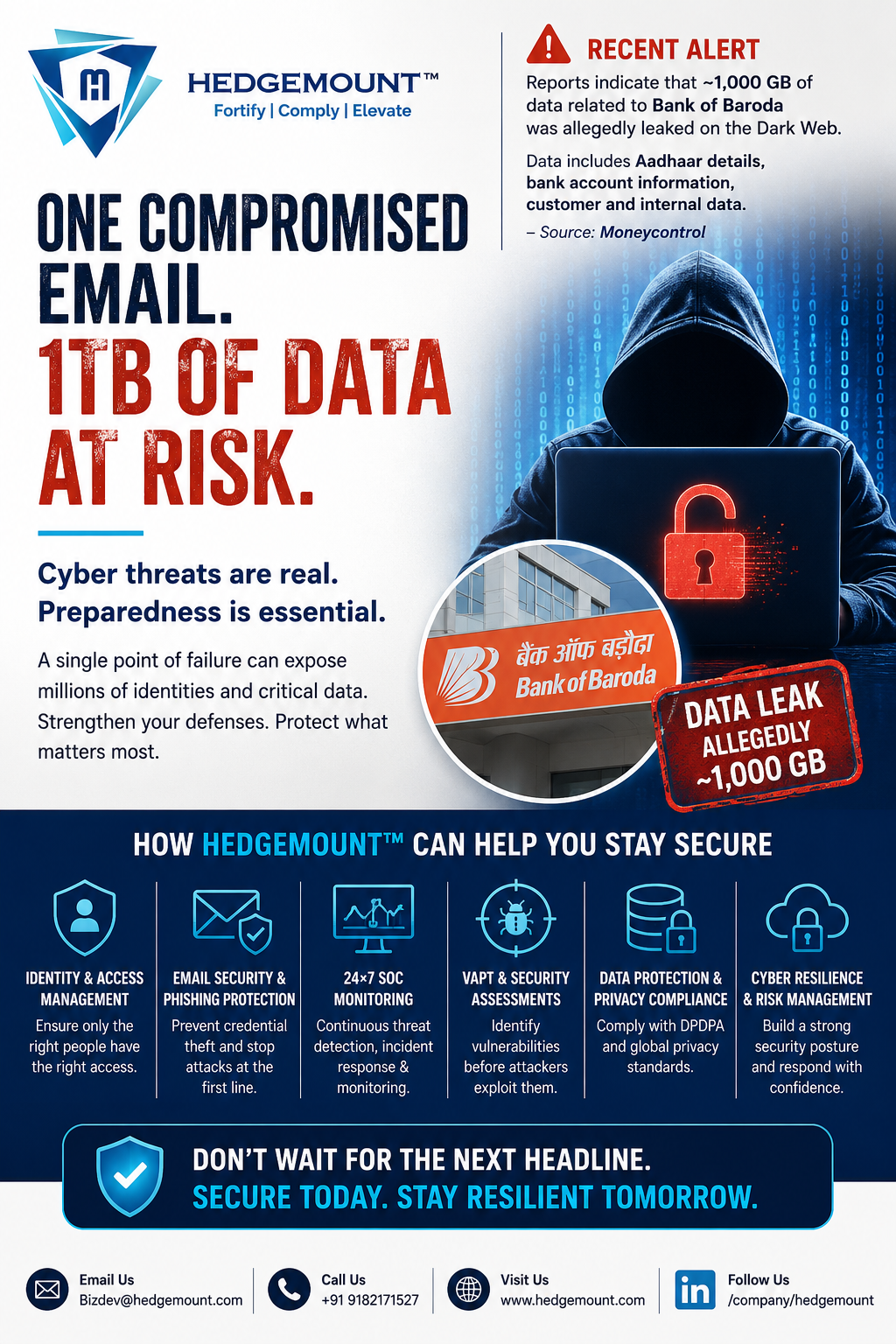
A recent cybersecurity incident involving Bank of Baroda has once again highlighted the growing importance of cybersecurity, data privacy, and proactive risk management across India’s financial sector. Reports indicate that approximately 1TB (1,000 GB) of data, including customer information and internal documents, was allegedly offered on the dark web.
According to public statements from Bank of Baroda, the incident was traced to the compromise of a single employee email account, resulting in unauthorized access to certain data. The bank has clarified that its core banking systems were not affected and continue to operate securely. A forensic investigation has been initiated, and the organization is working with relevant authorities to determine the full extent of the incident.
Bank of Baroda Data Leak: What Happened?
Media reports and cybersecurity researchers have indicated that the leaked dataset may include:
- Customer names and account information
- Aadhaar details
- Loan application records
- NetBanking information
- Internal audit documents
- Branch and ATM-related information
- Corporate and NRI banking records
The exact scope and number of affected customers have not yet been officially confirmed.
Key Takeaway: One Account Can Create Enterprise-Wide Risk
This incident reinforces a critical cybersecurity lesson:
Cybersecurity is only as strong as its weakest access point.
Even organizations with mature security programs remain vulnerable if identity management, email security, and continuous monitoring are not prioritized.
Organizations should consider implementing:
- Multi-Factor Authentication (MFA)
- Privileged Access Management (PAM)
- Email Security & Anti-Phishing Controls
- Vulnerability Assessment & Penetration Testing (VAPT)
- Security Awareness Training
- 24×7 Security Operations Center (SOC) Monitoring
- Data Loss Prevention (DLP)
- Incident Response Planning
- Privacy Compliance Programs (DPDP Act)
Why DPDPA Compliance Matters
The Digital Personal Data Protection (DPDP) Act, 2023 places increased emphasis on protecting personal information and implementing appropriate safeguards for data processing.
Incidents involving sensitive personal data serve as an important reminder that organizations handling customer information must establish:
- Data governance frameworks
- Consent management processes
- Breach response mechanisms
- Privacy impact assessments
- Continuous compliance monitoring
Failure to implement adequate safeguards can result in regulatory scrutiny, reputational damage, and loss of customer trust.
How HEDGEMOUNT Can Help Organizations Prevent Incidents Like the Bank of Baroda Data Leak
At HEDGEMOUNT™, we help organizations strengthen their cybersecurity and compliance posture through:
- ISO/IEC 27001:2022 Implementation
- SOC 2 Type I & Type II Readiness
- Vulnerability Assessment & Penetration Testing (VAPT)
- DPDP Act Compliance Advisory
- 24×7 SOC Monitoring & Threat Detection
- Internal Audits & Risk Assessments
- Security Awareness Programs
Cyber incidents are no longer a question of if, but when. Organizations that invest in resilience today will be better prepared to withstand tomorrow’s threats.
The original news source: Moneycontrol – Bank of Baroda Data Leak Article